跳至主要内容

Zipper Reciprocating Fatigue Testing Machine Testing preparation and process


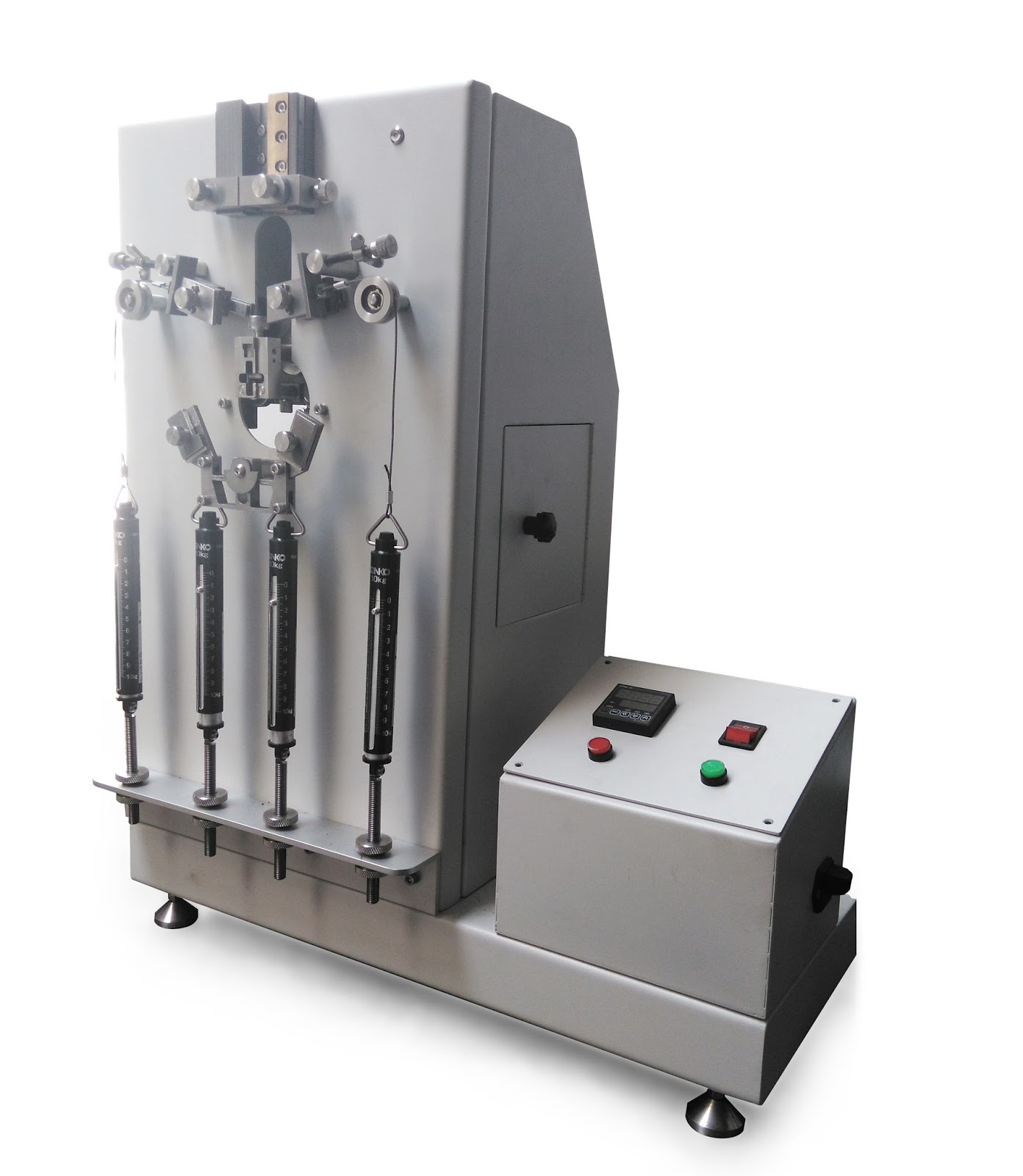
Zipper reciprocating fatigue testing machine before the test preparation1, adjust the knob until the pull tab clamping device B is at its highest position and insert a fixed pad in this unit.2. Fasten the zipper pull tab to the pull tab clamping device B.3, the first zipper tail (lower end) is roughly fixed in the upper part of the head on the A point (at this time the head center line and the zipper center vertical).4, the zipper front (upper end) fixed in the two longitudinal head E point.5, slightly loose the upper part of the clip A fixed point, pull the end of the zipper pull up so that the horizontal axis of the rotating plate G parallel with the film H, and then clamp the top of the head A point (at this time visual longitudinal head two E points in the same On the horizon)6, according to zipper type adjustment Longitudinal spring scale J upper and lower nuts Apply zipper tape with the appropriate vertical load as follows:7. Adjust the knob until the pull tab clamping device B is in the lowest position, and release the two horizontal gripping heads D so that both sides of the zipper are placed in the two clamps (this time, the two horizontal pins are perpendicular to the zipper And on the same horizontal line), the chuck should have a 5.0 mm clearance on both sides of the sprocket.8, according to the zipper model to adjust the horizontal spring scale I upper and lower nuts apply zipper cloth with the appropriate lateral load as shown in Table 2:9, adjust both sides of the adjustment screw C and both sides of the edge of the head D is 5.0 mm distance.


bag plastic zipper reciprocating pull tester test method:1. Tensile tensile test: bite zipper, fixture were fixed with the chain parallel to the cloth, with a certain speed vertical pull. To test the resistance strength of the zipper closure teeth.2. Single-tooth tensile test: the zipper separated, the fixture into a ring on its teeth. And then a certain speed vertical pull up,The strength of the bite resistance between the zippers and the cloth.3. Insert the transverse tensile strength: the fixture fixed to the edge of the tooth and inserted with the parallel, and then a certain speed vertical pull up. To test the strength of the occlusal resistance.4. Pull the head of the force test: pull the slider pull the middle of the zipper, and then pull the head in the locked (locked) state, the chain is separated and fixedAfter the pull. Test the strength of the pull head and the strength of the teeth in the chain.5. Under the transverse tensile test: the pull down to the bottom, the chain left and right fixed on the fixture. And then a certain speed vertical pull upPull to test the resistance of the zipper under the resistance.6. box, insert the straight pull test: the fixture vertical into the box, with a certain speed vertical pull up to test the gap between the box and the binding strength.7. on the vertical tensile test: pull the head to the top (at this time the zipper should be engaged), the pull film fixed in the fixture to pull up. MeasurementTry to stop the strength of the block.8. Pull the head of the comprehensive strength test: the fixture were the first body and pull the vertical fixed, and then afterburner pull until the head and the cap was pulled off only. Test the resistance strength of the cap.


Luggage zipper tester test zipper in the horizontal and vertical tension under the action, can withstand the required number of reciprocating pull operation, zipper reciprocating fatigue testing machine test machine to drive the zipper with constant speed pull, do 30 times per minute reciprocating Movement, until the specified number of times.Operating procedures1, according to the provisions of the test set the number of tests.2, press the START key, set the number of times after the machine automatically shut down, remove the sample, turn off the power.

评论

此博客中的热门博文

Classfication Of The Textile Testing

Textile testing is the term for a whole series of tests that examine the physical, mechanical and chemical properties of textiles. These tests are sometimes done before a textile goes into widespread use, or they're done on textiles arriving from other countries for sale in US markets. Countries like the United States have established standards for what should and should not be in textile products. Tests can show whether companies making textiles are in compliance or not. Many textile tests have many types. Some of them are physical tests, in which a sample of textile material is examined closely for feel and appearance. Such tests are done on individual fibers or strands of material and on yarns, threads made of several fibers twisted together. Textiles are subjected to light and other elements to see how they react. Some of these tests are done in a weather-ometer, a machine that tests for weathering and lightfastness of textiles. It's basically an enclosed box. Textiles...

Synthetic Blood Penetration Tester for Medical Face Mask

  Features of Synthetic Blood Penetration Tester: 1. Mask fixture is metal human head mold, which can fully simulate the actual use state of the mask. 2. Metal human head mold can be rotated at a certain angle, which is convenient for sample clamping. 3. Specially designed injection control device, a certain volume of synthetic blood can be sprayed in the controlled time. 4. Instrument uses a gas source that can provide (700±25) kPa stable air pressure. 5. It can simulate the liquid injection velocity corresponding to the human blood pressure 10.6 kPa、16.0kPa 、21.3kPa (i.e .80 mmHg、120mmHg、160mmHg) for the test. 6. A fixed target plate is provided to block the high pressure edge part of the ejected liquid flow, only the steady flow part is sprayed on the area sample, which increases the accuracy and repeatability of the test. 7. This blood penetration testing equipment uses imported special aluminum wire drawing panel, equipped with metal keys, sensitive operation, not easy to dama...

Determination of air permeability of a fabric-air permeability tester

Fabric air permeability is a measure to what extent it gives air passing through the fabric. Air permeability, a given area in the vertical direction of the air flow rate, a given time period, is measured by the fabric test area inside the pressure difference of the fabric. Basically, it depends on weight, thickness and porosity of fabric. The porosity of fabric is the demonstration of the air gap as a percentage within fabric. It has been important for especially the tent fabric, parachute fabric, raincoat fabric and garment, the fabric used in air bags, industrial filters and sail cloth. Moreover, when thermal properties of clothing and body interaction are taken into consideration, there has been the effect of air permeability. there is an instrument which is designed to test the air permeability of fabric on the market .it is air permeability tester . Air permeability is an important feature of fabrics (Sundaramoorthy et al., 2011) and is one of the main factors affecting the t...