跳至主要内容

Horizontal and vertical burning tester


UL94 horizontal and vertical combustion tester is designed to simulate the early firing situation of electronic and electrical products in order to evaluate the firing hazard through this simulation technology,. when the products are on fire the tester needs to ensure that the flame around the products shall not spread around. The tester is used to conduct flammability experiments for materials of equipment and  components, and measure the test indices, such as flammability property, burning rate, flame spread, combustion intensity and  the flame retardant property of products. It is a latest listed tester extremely recommended to clients with high requirements in terms of its high automation and accurate test data.

Features:

1. Chamber and fixture:
1.1 Chamber size:(W)1200mmX(D)600mmX(H)1300mm;
1.2 Extra large burning body at 0.55m³ to ensure adequate air supply while testing;
1.3 Chamber with paint baking treatment; inside dark painted baking (as per standards), anti-corrosion;
1.4 Integrated design composed of the test section and control unit, easy for sit installation and conditioning;
1.5 Large scale glass observation window, elegantly designed, easy to observe the burning state of materials;
1.6 Advanced industrial design conforming to ergonomic design, easy to touch the sample, set the burning rod and operate;
1.7 All clamps made of 304 stainless steel; nice and anti-corrosion; integrated design suitable for both horizontal and vertical burning; easy operation; space saving;
1.8 304 stainless steel flame height ruler
1.9 stainless steel ruler at ab accuracy of 0.5mm;
 
2. Burner and gas control:
2.1 Burning angle adjustable at  0° and 45°;
2.2 USA imported  Bunsen burner,length 100mm±10mm、inner diameter 9.5mm±0.3mm;totally comply with the requirements of IEC60695-11-4;
2.3 Self adjustable burner flow; self adjustable air volume in to the burner;
2.5 High precision pressure regulating valve and pressure gauge;
2.6 U-shape tube differential pressure gage;
2.7 Precise control of the flame height at 20mm±2mm
 
3. Automatic control system
3.1 programmable controller with 7 "touch screen achieves control/detection/calculation/data display.
3.2 Pulse high voltage electronic automatic ignition;
3.3 Timing button and PLC automatic record and storage of burning time;
3.4 Timer detects the time that flame reaches 25, 100mm mark line.Accuracy of 0.1 S, automatic timing;
3.5 No hand stopwatch or manuscript timing;The test time system records automatically and produces the test report.
3.6 Test time and flame time can be set on touch screen.Meet a variety of test standard requirements;
3.7 Linear combustion rate (V) by PLC automatic calculation, touch screen display and storage;
3.8 test grade value (HB0 HB40 HB75/ v-0 v-1 v-2) and the national standard specified value can be viewed on the screen;
3.9 Horizontal and vertical combustion test program can be switched on touch screen;
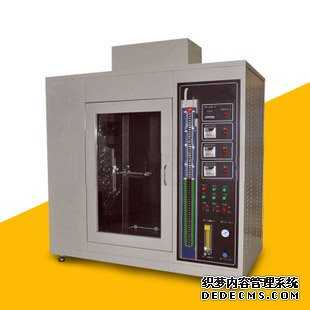
UL94 Horizontal-Vertical Flame Chamber

评论

此博客中的热门博文

Determination of air permeability of a fabric-air permeability tester

Fabric air permeability is a measure to what extent it gives air passing through the fabric. Air permeability, a given area in the vertical direction of the air flow rate, a given time period, is measured by the fabric test area inside the pressure difference of the fabric. Basically, it depends on weight, thickness and porosity of fabric. The porosity of fabric is the demonstration of the air gap as a percentage within fabric. It has been important for especially the tent fabric, parachute fabric, raincoat fabric and garment, the fabric used in air bags, industrial filters and sail cloth. Moreover, when thermal properties of clothing and body interaction are taken into consideration, there has been the effect of air permeability. there is an instrument which is designed to test the air permeability of fabric on the market .it is air permeability tester . Air permeability is an important feature of fabrics (Sundaramoorthy et al., 2011) and is one of the main factors affecting the t...

How To Process The Elmendorf Tear Strength Test

The Elmendorf tear tester has been developed specially for the paper industry and is outstanding for simplicity of operation and high measurement accuracy. The exchangeable pendulum is equipped with a pneumatic sample clamp. The initiation and return of the pendulum, as well as sample cutting is completely automatic. The device is operated via an integrated touch screen, where the test method can be selected, specific settings can be adjusted, and, after the measurement, results and statistics can be  displayed.Each pendulum is supplied with the appropriate control weight so that, with the help of the service program, it can easily be checked for functionality and balance. The Elmendorf tear test Procedure:     Cotton fabric was taken.     Warp and weft direction of the fabric was identified.     Two strips were cut from the fabric in both directions having dimensions of 100 x 63.5 mm.     The sample was then fixed in the jaws of the ...

Classfication Of The Textile Testing

Textile testing is the term for a whole series of tests that examine the physical, mechanical and chemical properties of textiles. These tests are sometimes done before a textile goes into widespread use, or they're done on textiles arriving from other countries for sale in US markets. Countries like the United States have established standards for what should and should not be in textile products. Tests can show whether companies making textiles are in compliance or not. Many textile tests have many types. Some of them are physical tests, in which a sample of textile material is examined closely for feel and appearance. Such tests are done on individual fibers or strands of material and on yarns, threads made of several fibers twisted together. Textiles are subjected to light and other elements to see how they react. Some of these tests are done in a weather-ometer, a machine that tests for weathering and lightfastness of textiles. It's basically an enclosed box. Textiles...